

How to Respond to an Emotionally Immature Parent Without Getting Pulled In
Why explaining, defending, and trying to be understood can keep you stuck in the same emotional cycle
By Sheena McRae Registered Psychotherapist
Women's Therapy Centre, Virtual Therapy Across Canada
You tell yourself you're going to keep it simple this time. Your parent makes a comment about your parenting, your relationship, how often you visit, or a decision you've made.
You answer. They push back. So you clarify. They misunderstand what you meant, and now you need to correct that too.
Before you know it, you're ten minutes into defending a decision you didn't actually need permission to make.
Maybe the conversation ends with them upset. Maybe it ends with you apologizing. Maybe you hang up and spend the next hour replaying everything you said, thinking of all the ways you could have explained yourself differently.
If you grew up with an emotionally immature parent, this kind of interaction can feel incredibly familiar. And one of the most important shifts I've seen women make is realizing that the goal of these conversations may need to change.
Instead of asking: How do I get them to understand?
We begin asking: How do I respond without getting pulled back into the pattern?
Those are very different goals.
Why You Keep Getting Pulled In
When we talk about emotionally immature parents, it's tempting to focus entirely on their behaviour.
Why do they make everything about themselves? Why can't they hear feedback? Why does every boundary become an argument? Why do I end up comforting them when I was the one who was hurt?
Those are understandable questions. But in therapy, I'm often just as interested in what happens inside you during the interaction.
Your chest tightens. You feel an immediate need to explain. You start searching for the perfect wording. You notice their disappointment and suddenly your boundary doesn't feel quite as reasonable as it did five minutes ago.
A part of you wants to end the conversation. Another part desperately wants them to understand. This is where early attachment experiences matter.
As children, we depend on our caregivers for connection, safety, and belonging. If maintaining that connection required you to manage a parent's emotions, avoid disappointing them, explain yourself carefully, or become exceptionally attuned to their reactions, your nervous system may have learned that relational tension requires immediate action.
You learned to do something when someone was unhappy with you.
Explain. Fix. Reassure. Apologize. Back down. Make them understand.
Those responses weren't character flaws. They were ways of navigating an important relationship. The difficulty is that your nervous system may still be using them decades later.
If this pattern sounds familiar, my article What Is an Attachment Injury and Why Does It Matter? explores how early relational experiences can continue shaping what feels safe in adult relationships.
When Explaining Becomes Part of the Cycle
There is nothing inherently unhealthy about explaining yourself. In emotionally mature relationships, explanations can create closeness. Two people can clarify misunderstandings, become curious about each other's perspectives, repair hurt, and occasionally change their minds.
The problem is assuming that more explanation will create emotional maturity in someone who isn't approaching the conversation that way.
You may say: "We're staying home for Christmas morning this year because we want the kids to have some time at home."
Your parent responds: "I guess family just isn't important to you anymore."
Now the temptation begins. "That's not what I mean. Of course family is important. We came last year, and we'll still see you Boxing Day, and the kids have been really tired, and..."
You've left the original boundary and entered a defence of your character. The conversation is no longer about Christmas. It's about proving you're a good daughter.
This is where many women become trapped. They believe if they can provide enough context, the other person will eventually say:
"Oh, I understand. That makes sense." Sometimes they will.
But if you've had the same conversation in fifteen different forms for twenty years, it may be worth considering whether the problem is really a lack of information.
If you're already thinking, But what am I supposed to say instead?, we've created a practical guide to responding to emotionally immature parents with examples you can adapt to your own conversations.
You Don't Have to JADE
A useful concept in difficult relational dynamics is JADE: Justify, Argue, Defend, Explain. Again, none of these behaviours are inherently bad. The issue is what happens when you repeatedly use them in an interaction where the other person isn't actually seeking clarification.
Your parent criticizes your decision. You justify it.
They challenge your justification. You defend it.
They introduce something you did six years ago. You argue that the situations aren't comparable.
They accuse you of being defensive. You explain why you're not.
And suddenly you're discussing everything except the decision you originally made. The interaction keeps receiving more material to work with. Sometimes a much more powerful response is considerably shorter.
"We've decided what works best for our family."
That's it. Not because you're being cold. Because your decision doesn't become more legitimate when someone else approves of it.
Warm Disengagement Is Different From Being Cold
When people first learn to disengage from emotionally immature dynamics, they sometimes imagine they need to become detached, emotionless, or harsh. I don't think that's always necessary.
You may love this person. You may want a relationship with them. You may understand their history and have compassion for why they are the way they are.
You can hold all of that without participating in every emotional invitation you're offered. I think of this as warm disengagement.
Your mother says: "You're obviously too busy for me now."
You could spend ten minutes proving that isn't true. Or you might say: "I know you'd like to see me more."
Notice what that response does. It acknowledges her feeling.
It doesn't agree that you've done something wrong. It doesn't defend your schedule. It doesn't promise to change anything.
It allows her disappointment to belong to her. That last part can be incredibly difficult if you grew up believing other people's uncomfortable emotions were yours to resolve.
Validation Does Not Mean Agreement
This distinction can change relationships. You can understand why someone feels something without agreeing with the story they've attached to the feeling.
"I can hear that you're disappointed." doesn't mean: "I shouldn't have made this decision."
"I understand that this isn't what you wanted." doesn't mean: "I'll change my mind."
"I know this is hard for you." doesn't mean: "It's my responsibility to make it easier."
Emotionally immature dynamics can make those things feel almost indistinguishable.
If someone is upset, you feel responsible. If someone misunderstands you, you need to correct them. If someone thinks badly of you, you need to prove otherwise.
Healing begins to create space between those experiences. Someone can be disappointed in you without you having done something wrong. That can be an enormous nervous system shift.
Shorter Is Often Harder
People sometimes hear advice like "stop explaining yourself" and assume the solution is simple. Just say less.
But if over-explaining developed as a way to preserve attachment, saying less can feel profoundly uncomfortable.
You send: "We won't be able to come this weekend, but I hope you have a great time."
Then you stare at your phone. Your nervous system immediately offers seventeen additional sentences.
Maybe I should explain why. She's going to think I'm selfish. What if she's angry? Maybe I should offer another day. That sounded cold. Should I add a heart?
This is the part of boundary work that doesn't get talked about enough.
Sometimes the difficult part isn't knowing what to say. It's tolerating what happens inside your body after you say it.
Your nervous system may interpret another person's disappointment as a threat to connection even when your adult mind knows you're allowed to make your own choices.
So the work becomes more than communication. Can you notice the urgency without immediately acting on it? Can you allow someone to misunderstand you temporarily? Can you tolerate the possibility that they may not like your decision? Can you remind your nervous system that disagreement is not the same thing as abandonment?
This is where nervous system-focused and attachment-based therapy can be especially helpful. We aren't only practising better sentences. We're exploring why saying those sentences feels so dangerous in the first place.
Stop Trying to Find the Perfect Response
There is another trap I see frequently. Once people learn about emotionally immature dynamics, they begin searching for the perfect response.
The sentence that will shut down the guilt trip. The boundary the parent can't argue with. The wording that finally makes them see how unreasonable they're being.
Unfortunately, that can become another version of the same pattern.
You're still trying to control the other person's response. Just with better boundaries.
There may be no sentence that makes an emotionally immature person respond maturely. Your boundary can be thoughtful, kind, fair, and beautifully worded—and they can still dislike it. The success of a boundary isn't measured by how well the other person receives it.
Sometimes success looks like saying what you needed to say and allowing their reaction to exist without rushing in to manage it.
What Can You Say Instead?
The most effective responses are often remarkably ordinary.
If they criticize your decision: "I'm comfortable with my decision."
If they keep pushing: "I've already answered that."
If they guilt you: "I understand you're disappointed."
If they tell you what you "should" do: "I'll think about that."
If they misrepresent your intentions: "That's not how I see it."
If they demand an immediate answer: "I need some time to think about it."
If they keep reopening a conversation you've already had: "I don't have anything else to add."
If the interaction becomes disrespectful: "I'm going to end the conversation for now. We can talk another time."
Notice how little information these responses provide.
That's intentional. You're communicating. You're just no longer submitting evidence for cross-examination.
If you recognize how difficult it is to stop explaining once someone questions you, I've written more about that pattern in Why Do I Keep Explaining Myself?
The Pause May Be More Important Than the Words
Before responding to an emotionally immature person, I often want clients to notice one thing: urgency.
The need to respond right now can be a clue that your nervous system has become activated. You receive a text. Your heart starts racing.
You immediately begin composing a paragraph. Stop.
You don't necessarily need to answer while your nervous system is trying to protect you. Put the phone down. Walk around the room. Notice your feet against the floor. Take a shower. Go outside. Talk to someone grounded. Write the response without sending it. Then return when you feel more like your adult self and less like the child who needs to restore connection immediately.
Sometimes the most powerful response isn't a clever sentence. It's twenty minutes. Or two hours. Or deciding that the message doesn't actually require a response at all.
Ask Yourself What You're Trying to Accomplish
Before you send the fourth paragraph, try asking yourself: Am I communicating—or am I trying to make them understand, agree, calm down, or approve of me?
There is nothing shameful about wanting those things. Of course you want your parent to understand you. Of course you want them to see your intentions. Of course some part of you still hopes this conversation will be different.
But noticing what you're trying to accomplish gives you a choice. If your goal is communication, perhaps you've already communicated. If your goal is making an emotionally immature person agree with your reality, you may be entering a conversation that has no natural ending. You don't have to attend every argument you're invited to.
What If They Think You're Selfish?
They might. This can be one of the hardest parts.
You may finally learn to communicate differently and discover that the other person doesn't like the new version of the relationship. When you stop over-explaining, they may call you cold. When you stop immediately answering, they may say you've changed. When you stop fixing their disappointment, they may call you selfish. When you begin setting boundaries, they may tell you therapy has made you worse.
That doesn't automatically mean you're doing something wrong.
Relationships develop patterns, and when one person stops playing their familiar role, the entire system has to adjust. If you've historically been the peacekeeper, caretaker, apologizer, or emotionally responsible child, your change may initially create more tension rather than less. That's why I don't think healing can be measured only by whether your relationships become more peaceful.
Sometimes healing initially looks like becoming more able to tolerate conflict without abandoning yourself to make it disappear.
You Can Love Someone Without Giving Them Unlimited Access to You
There is often pressure to make relationships with parents fit into one of two categories. Close or estranged. Forgiven or unforgiven. Good or toxic.
Real relationships are often much more complicated. You may love your parent and recognize their limitations. You may enjoy certain parts of the relationship and protect yourself from others. You may decide some topics are no longer open for discussion. You may shorten visits. Respond to texts later. Share less personal information. Choose not to seek emotional support from someone who has repeatedly shown they cannot provide it. None of those choices require you to decide that your parent is a terrible person.
They simply require you to become more realistic about the relationship that is actually available to you. One of the painful parts of understanding emotionally immature parents is grieving the relationship you continue hoping might exist someday. But there can also be freedom in no longer asking someone to consistently provide something they have repeatedly shown they struggle to give.
The Goal Isn't to Become Emotionally Immature Too
Disengaging doesn't mean punishing. It doesn't mean intentionally withholding affection, giving the silent treatment, or trying to make the other person feel powerless. The goal isn't to beat an emotionally immature person at their own game.
It's to stop playing the game. You can be clear without being cruel. Brief without being dismissive. Boundaried without being punitive. Compassionate without becoming responsible for someone else's emotions.
Sometimes the healthiest response sounds almost boring. That's often a good sign. There is less emotional fuel. Less defending. Less proving. Less urgency. Less of you disappearing into someone else's reaction.
Knowing Why You Over-Explain Is One Thing. Knowing What to Say Instead Is Another.
If you're used to explaining, defending, or trying to get an emotionally immature parent to understand your perspective, simply deciding to “stop over-explaining” can leave you wondering what you're supposed to say instead.
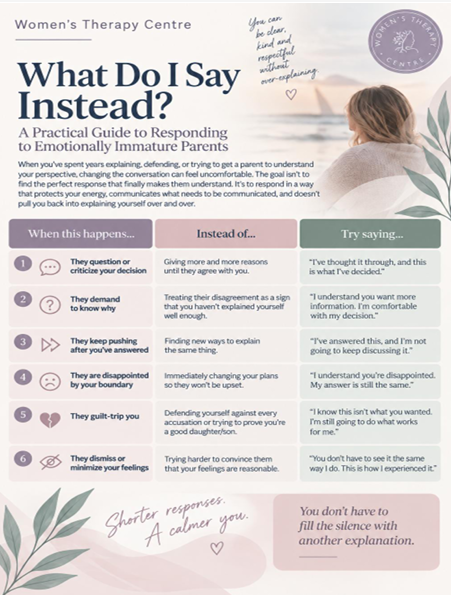
We've created a free two-page guide with practical responses for some of the moments that can pull you back into old patterns—from guilt trips and criticism to boundary-pushing, defensiveness, and conversations that keep going in circles.
Keep it somewhere easy to come back to. You don't need to memorize the responses or say them word-for-word. Think of them as examples of what it can sound like to communicate clearly without making the other person's agreement the goal.
Free Resource: What Do I Say Instead?
Practical scripts for responding to emotionally immature parents without getting pulled back into explaining, defending, or trying to be understood.
Download the Free Guide →
When You Understand the Pattern but Still Can't Stop Doing It
This is where many women become frustrated with themselves. They've read about emotionally immature parents. They understand attachment. They know they're people-pleasing. They recognize the guilt trip while it's happening.
And then their mother sends one text and suddenly they're fourteen again. This doesn't mean the insight hasn't worked. It means these patterns aren't stored only as ideas. They're relational and nervous-system patterns that have often been rehearsed for decades.
This is part of why I use attachment-focused, nervous system-informed approaches and EMDR in my work. We can understand the pattern intellectually while also exploring the earlier experiences that taught your nervous system that someone's anger, withdrawal, disappointment, or disapproval required you to act.
The goal isn't to become someone who never gets activated. It's to create more space between activation and response.
More ability to notice:
There it is.
I want to explain.
I want to fix this.
I want them to understand.
And I don't have to. That space is where choice begins.
You Don't Need Their Understanding to Trust Yourself
Perhaps the deepest shift isn't learning what to say to an emotionally immature parent. It's changing what you believe needs to happen after you say it. You can communicate clearly and still be misunderstood. Set a reasonable boundary and still disappoint someone. Make a healthy decision and still feel guilty. Say no and still love the person you're saying no to. Let someone have an inaccurate opinion of you without immediately building a case for your defence.
For someone who grew up monitoring a parent's emotional state, these can feel like enormous acts. But gradually, your nervous system begins learning something new. Someone else can have feelings...and you can remain okay.
Someone can disagree...and you can remain connected to yourself.
Someone can misunderstand you...and you don't have to spend the rest of the evening trying to change their mind.
The goal isn't to become indifferent. It's to stop requiring someone else's emotional regulation, approval, or understanding before you're allowed to trust your own experience.
Sometimes the most powerful response to an emotionally immature person isn't the perfect sentence. It's realizing you've already said enough.
You don't have to keep explaining a boundary simply because someone doesn't like it.
Why Work With Sheena?
Many of the women I work with already understand their patterns intellectually. They know they people-please, over-explain, feel responsible for other people's emotions, or become intensely activated by conflict. What they often don't understand is why knowing this hasn't been enough to change it.
Using attachment-focused, nervous system-informed therapy and EMDR, I help women explore how early relational experiences shaped these responses, how the nervous system continues carrying them today, and how those patterns can begin to shift.
Frequently Asked Questions
How do you respond to an emotionally immature parent?
Keep your response clear and concise, particularly when a conversation has become repetitive or defensive. You can acknowledge another person's feelings without agreeing with their interpretation, and you don't need to repeatedly justify a decision or boundary simply because they dislike it.
Why do I over-explain to my parents?
Over-explaining can develop when maintaining connection in childhood required you to carefully manage a caregiver's reactions, avoid disappointing them, or prove that your feelings and decisions were reasonable. In adulthood, your nervous system may continue treating disagreement or disapproval as something that needs to be resolved immediately.
What is JADE in difficult relationships?
JADE stands for justify, argue, defend, and explain. It describes ways we can become pulled into prolonged interactions by repeatedly trying to prove or defend our decisions. The goal isn't to never explain yourself, but to recognize when additional explanation is no longer creating understanding.
How can I set boundaries without being cold?
Boundaries can be both warm and clear. You might acknowledge someone's disappointment while maintaining your decision: "I understand this isn't what you hoped for, but this is what works for me." Compassion does not require changing your boundary.
Why do I feel guilty after setting a boundary with my parent?
If you learned early that a parent's disappointment, anger, or withdrawal threatened connection, setting a boundary can activate old attachment and nervous-system responses. Feeling guilty does not necessarily mean the boundary was wrong; sometimes it reflects how unfamiliar it feels to let another person manage their own emotions.
Can EMDR help with patterns from emotionally immature parents?
EMDR may be used to process distressing experiences and beliefs connected to earlier relationships. In attachment-focused therapy, it can be integrated with work exploring the relational and nervous-system patterns that continue to become activated in present-day interactions.
August 27, 2026
Topics: Relationships & Family Life
About the Author